About ORIGIN

One connected system — from microbial diversity to pilot-scale ingredients.

Available
Planned
The challenge

Natural ingredients are under pressure

Demand for naturally derived ingredients used in nutraceuticals, cosmetics, flavours, fragrances and pharmaceuticals continues to grow. Yet many supply chains still rely on wild harvesting, long agricultural cycles and geographically concentrated sources. This can place pressure on biodiversity, create variable product quality and expose producers and consumers to supply, adulteration and safety risks.

Precision fermentation offers a more resilient route, but developing a new microbial production process can still take five to ten years. Current workflows are often fragmented and costly, and are developed one molecule at a time.


The ORIGIN response

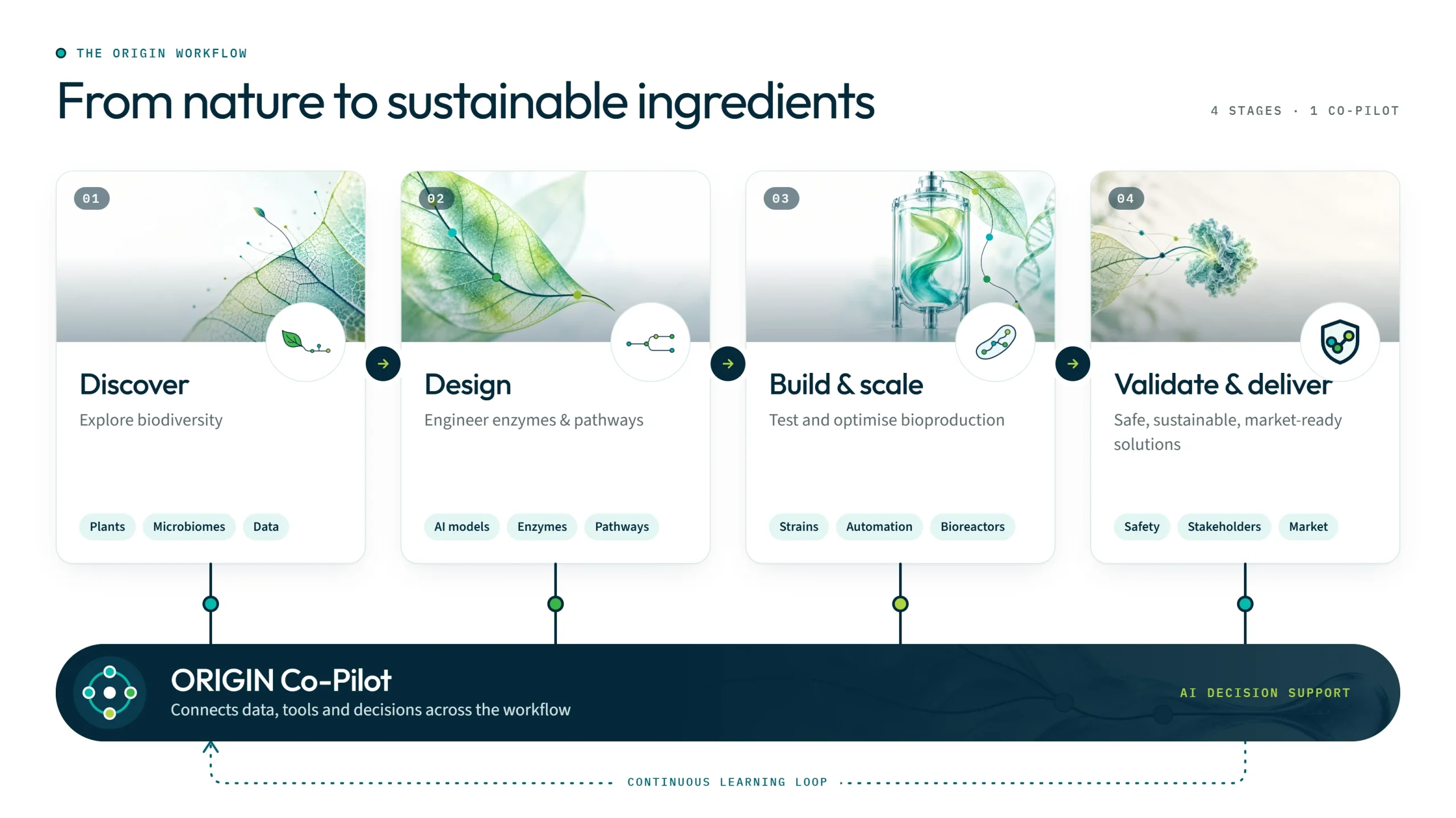
The complete development pathway in one connected system

The project spans large-scale digital exploration of microbial diversity, AI-driven retrosynthesis, enzyme engineering, rapid prototyping across multiple microbial hosts, fermentation scale-up, and early economic, safety, regulatory and environmental assessment.

The ORIGIN Co-pilot links data and learning across the project, supporting traceable, evidence-based decisions throughout repeated Design–Build–Test–Learn cycles.

What ORIGIN aims to achieve

Project targets
2–3
yrs

Faster ingredient development

Reducing timelines from the current 5–10 years

3

Lead processes at 30–100 L

Targeting more than 10 g/L and more than 95% purity

>90%*

Lower land use

Alongside 30–50% lower greenhouse-gas emissions and at least 70% water savings per kg of ingredient

SSbD

Safe and Sustainable by Design

Applied from development through scale-up and de-risking

* Environmental figures are targets compared with relevant conventional production baselines. They will be evaluated through the project’s techno-economic and life-cycle assessment work and are not verified results.

Project facts

Full title

Optimized Routing and Industrial Generation of Ingredients from Nature

Acronym

ORIGIN

Grant Agreement

101289831

Programme

Horizon Europe

Call

HORIZON-CL6-2025-01

Topic

HORIZON-CL6-2025-01-CIRCBIO-08

Type of action

Innovation Action

Duration

48 months, from June 2026

Max. EU contribution

€5,498,237

Coordinator

SilicoLife SA

Consortium

7 partners · 6 countries

Objectives

Seven connected objectives spanning discovery, design, experimental validation, scale-up, de-risking, exploitation and project integration.

01

Discover novel microbial enzymes

Establish a high-potential portfolio of microbial enzymes for sustainable ingredient production through AI-assisted digital bioprospecting.

02

Design build-ready pathways

Create AI-optimised, host-aware biosynthetic pathway blueprints for 50 high-potential molecules.

03

Build and screen microbial prototypes

Construct and test a diverse multi-host strain library and select the 10 best-performing molecule/host combinations.

04

Demonstrate pilot-scale production

Optimise the 10 lead strains and demonstrate three robust production processes at 30–100 L scale, targeting TRL 7.

05

Confirm safety and sustainability

Generate pre-regulatory safety, toxicokinetic, techno-economic and life-cycle evidence for the lead candidates.

06

Create routes to uptake and impact

Develop investor-ready product roadmaps, manage intellectual property, communicate results and engage citizens and stakeholders.

07

Connect knowledge and execution

Coordinate the consortium and develop the ORIGIN Co-pilot as a shared intelligence, data-integration and learning layer.

Approach & workflow

One connected discovery-to-production funnel

ORIGIN explores a broad portfolio of natural molecules and biological diversity, then uses evidence-based filters to focus resources on the most promising candidates.

Click in the image to enlarge

01
Prioritise

Prioritise high-value natural molecules

02
Discover

Discover microbial enzymes and biosynthetic gene clusters

03
Design

Design host-aware pathways and improved enzymes with AI

04
Build & test

Build and test candidate strains across multiple microbial hosts

05
Scale

Optimise and scale fermentation processes

06
Assess

Assess and de-risk economics, safety, sustainability and regulation

07
Translate

Translate validated outputs into tools, policy insights and product roadmaps

Four pillars, seven work packages

WP1

Discovery

Explore global microbial diversity to identify promising enzymes and biosynthetic gene clusters.

WP2 - WP3

High-throughput design & implementation

Use AI to design pathways and enzymes, then build and test them across multiple microbial hosts.

WP4 - WP5

Industrial scale-up & de-risking

Optimise fermentation, demonstrate lead processes and evaluate their economic, safety, regulatory and environmental performance.

WP6 - WP7

Integration & exploitation

Translate results into impact, public engagement and routes to uptake, connected through the ORIGIN Co-pilot.

WP1AI-Assisted Digital Bioprospecting & BGC MiningLead · CSIC

WP1 explores public and proprietary genomic resources to identify microbial enzymes and biosynthetic gene clusters with potential for natural-ingredient production. Sequence-, structure- and genomic-context methods help discover candidates beyond cultivated microorganisms, while provenance and Access and Benefit-Sharing requirements support responsible and traceable biodiscovery.

WP2 turns target molecules and enzyme candidates into ranked, host-aware biosynthetic pathway designs. Retrosynthesis, metabolic modelling and generative enzyme engineering are combined to identify feasible routes, anticipate bottlenecks and create build-ready blueprints for experimental testing.

WP3 translates digital designs into physical microbial prototypes. High-throughput automation and iterative Design–Build–Test–Learn cycles are applied across E. coli, Saccharomyces cerevisiae, Yarrowia lipolytica and Aspergillus niger to identify and improve the most promising molecule–pathway–host combinations.

WP4 develops robust fermentation and downstream-processing methods for the lead strains. Processes are optimised starting from small-scale bioreactors, and the three most promising candidates are advanced to pilot demonstration at 30–100 L, generating material and data for subsequent assessment.

WP5 evaluates whether the emerging processes are economically viable, safe, sustainable and suitable for future market entry. It combines early techno-economic screening, life-cycle assessment, pre-regulatory safety and toxicokinetic studies, and regulatory planning for Europe and the United States.

WP6 turns scientific and technical outputs into protected, visible and usable assets. It covers intellectual-property strategy, product roadmaps, policy briefs, communication and dissemination, stakeholder engagement and the NOVA-led Citizen Science initiative.

WP7 provides project coordination, governance, risk and quality management, data management and development of the ORIGIN Co-pilot. The Co-pilot is designed to connect structured knowledge across all work packages, support reproducibility and improve project-wide learning and decision-making.

Consortium · 7 partners · 6 countries

Expertise across the complete bioproduction value chain

Academic excellence, advanced research infrastructure, specialist SMEs and industrial biotechnology expertise — covering every stage from genomic biodiscovery and AI-enabled design to strain engineering, pilot-scale fermentation, safety and sustainability assessment, exploitation and public engagement.

SilicoLife

SilicoLife SA

Coordinator

Portugal

Coordinates ORIGIN and leads project management, the ORIGIN Co-pilot, exploitation, intellectual-property strategy and communication. SilicoLife also contributes AI-enabled pathway and protein engineering, microbial prototyping and integrated TEA/LCA workflows.

Technical University of Denmark

Technical University of Denmark (DTU)

Denmark

Leads fermentation optimisation and pilot-scale production. DTU contributes its Pre-Pilot Plant, downstream-processing expertise and techno-economic and life-cycle assessment capabilities to translate lead strains into scalable processes.

CSIC

Spanish National Research Council (CSIC)

Spain

Leads AI-assisted digital bioprospecting and biosynthetic gene-cluster mining. CSIC applies large-scale bioinformatics to discover and prioritise novel microbial enzymes while supporting sequence provenance and responsible biodiscovery.

Basecamp Research

Basecamp Research Ltd.

United Kingdom

Contributes BaseData™, a large, globally sourced and Nagoya-compliant metagenomic resource, together with AI and computing capabilities for enzyme, protein-structure and biosynthetic gene-cluster discovery.

EPFL

École Polytechnique Fédérale de Lausanne (EPFL)

Switzerland

Leads AI-driven retrosynthesis and host-aware pathway and strain design. EPFL applies computational biology, metabolic modelling and AI tools to produce ranked, build-ready pathway blueprints for experimental validation.

dsm-firmenich

dsm-firmenich

The Netherlands

Leads AI-assisted strain engineering and high-throughput prototyping, with particular expertise in Aspergillus niger. dsm-firmenich connects automated strain construction and screening with industrial bioprocess development and scale-up.

NOVA University Lisbon

NOVA University Lisbon

Portugal

Leads economic, safety, regulatory and sustainability assessment and the Citizen Science initiative. NOVA also contributes generative AI for enzyme engineering, microbial prototyping, pre-regulatory testing, communication and societal engagement.